Monday, November 20, 2006

Who Should be in Control?


I was reading Dana Blankenhorn's blog on ZDNet about control being the real advantage of open source software. You can read the blog here. Dana does a great job of really putting it into simple terms: control over your applications and your budget. Simply put, do you want to be in control of your code and your costs?

In previous blogs, I talk about software vendors and their true motivation: selling more software licenses. I often tell people that Microsoft is a great alternative if you are an all Microsoft shop, but you had better plan on living within a well defined strategy that pulls you in and makes you prisoner to a well defined revenue generating upgrade path. I have always marveled at the Microsoft upgrade machine and how it pulls you down the path. Check out this timeline of the Windows OS only. It is simply amazing since pretty much every point on that timeline represents a software license bought by millions.

So when is K-12 education willing to take control? There are applications out there now that bear scrutiny for production use. A search on Sourceforge with the keyword education yields 267 education related projects. SchoolForge compiles lists of open source software and links to other sites that maintain lists. There are probably another 50 software titles in all of these sites. Point is, there are plenty of foundations out there now that a district can take and build out further.

Like I ask many districts, why aren't you trying open source? It is time to take control of your software and associated costs.


Wednesday, November 15, 2006

Open Standards or Which Garden Hose Would You Like to Buy?

I want to revisit an earlier blog I wrote on open standards. I am always reading and learning whenever I possibly can. A recent book I read, Thomas Friedman's The World is Flat, talks about standards and the advent of the Internet, This part of his 10 "flatteners" that he details in the book. I began to think about technology leaps and the Internet is one of those that really is amazing if you think about the short time of its existence. After Al Gore created the Internet and Netscape released its browser, our world and the way that we communicate, research, do business and so on has fundamentally changed.

I often like to ask people the question "When is the last time you composed a handwritten letter?" Email has become the defacto form of written communication for many of us and handwritten letters are a thing of the past. How many of you set up your bills to be paid automatically with your on-line banking service? How many of you buy things on-line from people in other countries? The list of ways the Internet has changed our lives goes on and on in numerous directions.

What has made this amazing transformation able to take place in such a short period of time? The answer may surprise you in its simplicity, but let me give you a layman's example first. When you go to the Home Depot, Lowe's or a local hardware store to buy a garden hose, do you ever think about having to buy a hose with a certain fitting for your specific faucet at your house? Should I get a 5/8 or 3/4 size fitting? Of course not! Why? Because faucets are produced in a STANDARD size. Instead of having to worry about a fitting size, you only concentrate on what you need the hose to do. You might need a soaker hose for your shrub bed. You might need a hose that retains its elasticity in cold climates since you live in the far North. You might need one of those hoses that rolls flat when all of the water is out of it to conserve space. What you don't need is different faucet fittings because they are all STANDARD.

Standards. Have you ever really thought about the Internet? Most of us double click our Internet Explorer icon, connect to the Internet and go about our business. We never think about what happens behind the scenes, but that is where the real power of standards emerges. Let's take a quick test:

1) What does HTTP stand for?
2) What does HTML stand for?
3) What does FTP stand for?
4) What does SMTP stand for?
5) What does TCP/IP stand for?

Answers
1)Hyper Text Trasnsport Protocol - This is the protocol that enables a web browser to parse a URL and take you to that destination

2) Hyper text Markup Language - This is the standard lanuage that tells web browsers how to format the web page before presenting it to the end user.
3) File Transfer Protocol - This enables the transfer of files from one computer to another. An example is uploading a video file to youtube.com
4) Simple Mail Transfer Protocol - This is how email is exchanged. Post Ofice Protocol or POP is another email standard that allows you to get email from a mail server
5) Transmission Control Protocol/Internet Protocol - This is how the computers and routers move Internet traffic, which is really data packets

Five technology standards that have fundamentally changed the world in many ways. What if K-12 education chose to go the same path and adopt universal technology standards? What if K-12 chose to uniformly adopt the SCORM standards for managing instructional content? All vendors who produce instructional management systems and all publishers would have to adhere to the standard. So the focus would change from what is the best technology solution to what is simply the best solution. Much like garden hoses, districts would choose the best instructional management system without worrying about the technology or which publishers content was compatible with the instructional management system.

What about interoperability standards like SIF? What if school districts told all of their vendors that they were required to have SIF agents on their applications? I can guarantee you that the vendors would step up and produce SIF agents to be able to compete for the business. If standards can fundamentally change the world and its use of the Internet, why wouldn't K-12 education take the same path? I don't know the answer to this question, but would love your opinions.

Advocate open standards to your district technology leaders so that you have freedom of choice and not a vendor upgrade path. There are many open source applications that adhere to open standards that are widely used today that your district can employ as well. I recently asked someone how many computers they had in their district: 35,000. I then asked if they had Microsoft Office on every computer: Yes I then asked how much they paid per license: $15. Hmmmmm, let's see: $15 X 35,000 computers = $525,000. So then I asked why they weren't using Open Office, a open source, open standard office productivity suite: They didn't know about it, but when confronted with the idea, couldn't come up with a reason not to consider it.

I have always told people that Microsoft makes excellent products that are very well integrated, which is great if you are an all Microsoft shop. But one thing that you had to realize is that Microsoft is a software company. They exist solely to sell us software licenses in ever increasing amounts. So if you plan to be a Microsoft shop, plan on constant upgrades because that is what keeps Microsoft in business. But if you can return $525,000 to your operational budget by using a free office package that gets regular upgrades from its development community, why wouldn't you? When is good enough good enough for an industry that always screams we don't have enough money?

Open standards. Flexible infrastructure. Leverage your vendors instead of being restricted by your vendors. Be a pioneer and lead K-12 to its next transformation. Look at Brandon Elementary School in Atlanta and how they used the K-12 Linux Terminal Server Project, an open source solution, to decrease computer down time, increase life cycles of hardware, reuse older equipment and decrease costs associated with maintenance. What a great idea!

Open standards. Flexible infrastructure. Be a pioneer.

Instructional System Design


Working in K-12 is great for someone who likes to work on complex issues. For me, education truly represents a challenging public institution that is beset by bureaucracy, run under archaic rules, facing demanding state and federal legislation and, at times, plagued by individuals who have no business being in education. School boards are an especially sore spot for me since many representatives are elected and truly do not have the skills necessary to govern the business of a school district.

But within this challenging environment are a number of very bright people who are dedicated to helping find solutions to the many issues that confront K-12. One of the areas that is widely discussed is school reform or school improvement in support of student achievement. Many of these approaches are based on W. Edwards Deming's continuous improvement model and use an iterative repeating approach that can be described as Plan, Do, Check and Act. Several people have taken this approach and turned it into a repeatable methodology. The 8 Step Instructional Method was coined by Pat Davenport and Gerry Anderson at Brazosport ISD. Larry Lezotte has built an entire company around Effective Schools and Tom Guskey has built a Mastery of Learning method around Benjamin Bloom's work.

All of these methods are dependent on at least three universal items: good curriculum, effective instruction and sound instructional system design. While I have been knowledgeable of school reform and the many experts and companies around it, I was not familiar with the concept of Instructional System Design. That was until a friend of mine at Tetradata recommended a book to me: Fix Schools First: Blueprint for Achieving Learning Standards by Jack Bowsher, a former IBM VP in charge of corporate training.

In his book, Jack educates the reader on Instructional System Design (ISD), which is an approach developed by the military in WWII. In WWII, the military faced the task of taking thousands of untrained troops and having to get them trained very quickly on complex equipment and military tactics to be ready for battle. The system developed, ISD, was based largely on Robert Gagne's Conditions of Learning and the Nine Events of Instruction

Jack advocates the theory that everyone, except for the few such as severely disabled, can master curriculum content if effective ISD has been executed. Jack, like myself, is a proponent of curriculum standards, integrated curriculum, frequent assessment to determine mastery and required mastery of standards for advancement. Jack correctly presents an approach that is standardized and top down. Challenging curriculum standards are developed by government agencies, district directors of curriculum and instruction design a supporting curriculum with appropriate content, teachers are given the foundation of the curriculum and then personalize it for their classrooms, students are frequently assessed to determine mastery and specific professional development is given to teachers in support of their efforts.

Today, we see many teachers designing their own lesson plans and many districts with multiple curriculum's and differing curriculum resources. Teachers don't have the time to develop curriculum lesson plans and content and their time is better spent on delivering instruction effectively. And students who are highly mobile within their district, should not have to encounter a different curriculum or instructional calendar as they move to a different school. All lesson plans should have the same instructional approach and method to determine mastery. Common standards, common content and common assessment allow us to then use data to accurately measure and analyze our efforts to determine success.

ISD merits your attention if you have not learned about it yet. Gagne's 9 Events of Instruction are a practical approach designed for success that should be of value to any educator as well. Good ISD is a complex effort and should not be taken lightly, but rather well thought out and implemented to survive transition in leadership and district administration. Follow the links in the blog and explore these ideas. I believe they have foundation and can help you be successful in successful education for all students.


Friday, December 02, 2005

Open Standards

There is always talk about open source technologies and how they will become the Microsoft killers.  How Linux will ultimately defeat Windows in the desktop environment as people begin to get the open source concept, the skills develop and the ROI and TCO issues are fully fleshed out.  It may happen; it just isn’t going to happen anytime soon.

I think a better discussion is around open standards.  In the education world, there are many standards bodies that work diligently to create standards of interoperability, classification, taxonomy, etc.  SIF, SCORM, IMS, Dublin Core are examples of standards bodies that have made good progress and actually have fairly mature standards that are open to the general public.

While standards have had a slow go of it, especially in the U.S., recent events suggest that they may be gaining traction.  Language around SIF is being seen in many RFP’s issued by educational agencies.  The USDOE’s national technology plan even calls for it directly. Instructional management systems are aligning to SCORM and IMS as a method to classify and distribute content. Digital learning objects, just in their infancy, are beginning to see standards that are applicable in the Dublin Core and SCORM that make their use a practical reality.

Industry vendors are also showing some surprising moves. Microsoft recently capitulated and opened up its Office document formats.  Microsoft is also aligning its educational software to these recognized standards as well.  Independent vendors providing education solutions and products are jumping on the bandwagon as well.  All are good signs that we are moving towards an environment of a K-12 ecosystem or what many refer to as a services oriented architecture.

Let’s face it: There is no one vendor or system out there that has all of the best products or solutions for the education space.  It is a highly fractured marketplace with many niche vendors providing many different products and solutions that all fit different needs.  Some are open source, many are built on Microsoft technologies and there are some being built in the J2EE environments.  Different operating systems, different architectures and different communication systems all guarantee that we will likely never see true interoperability between vendor applications in my lifetime.

But we should be able to get everyone to agree on a set of standards that all products can adhere to for classification of education data points.  Why should we be able to do that?  It offers real benefits for both education clients and vendors.  It gives clients the ability to build an infrastructure around standards, not proprietary technologies.  It allows clients to choose products and solutions based on their merits, not their technology or fit with existing systems.

For vendors, the competition then focuses on the product or solution itself, not the technology.  The real competition becomes focused on the capabilities of the product, the ease of use, the fit to the needs of the industry, etc.  Vendors make better products and clients get more flexible service oriented architectures and they both win in the end.  An important point here is that the vendor with the best products wins.  When you implement standards, the technology platform becomes a consumer choice.  Who cares if it is open source, Microsoft, Linux or Unix?  It doesn’t matter because the technology uses the standards to talk to other technologies.  The clients will buy according to their needs, their skills and their budgets.  The real battle then comes down to who has the best product that most closely fits the client needs.

So how do we get open standards moving at an accelerated pace?  I don’t think that we can continue to rely on the process in place today. There needs to be some investment and direction from a larger body that can help propel the process forward.  I think that some steps have to be taken to set the stage.  Almost all states and districts are now incorporating curriculum standards into their educational processes.  These standards need to be merged together into a set of national curriculum standards that represent a challenging curriculum for students.

With a national set of standards, standards for the classification and sequencing of digital learning objects can be finalized, standards for the classification of instructional content can be finalized, standards for benchmark assessments can be finalized and a schema based on an open communication standard, such as XML, can be developed and adopted by all.  This isn’t going to happen in today’s environment without some assistance and intervention from national organizations.  ISTE, CoSN, SETDA, CCSSO, national education bodies and the USDOE are all going to have make a rallying cry and begin to demand of vendors that standards be developed and adhered to within their products.  We also will need investment in the form of grants.

Only then will we see progress being made that truly supports our most precious resource, children, and our economic future in the years ahead.

Thursday, October 13, 2005

Losing My Laptop and Returning Time to the Classroom

I work in technology, I thrive on technology and more importantly I depend on technology.  I recently had a hard drive crash on my laptop and lost my operating system.  I actually back things up, so I didn’t lose my important documents and items critical to my existence and work functions.

I tried to reinstall Windows but could never get it to boot up and had to get a new hard drive and Windows image.  While I was waiting on that to happen, I installed a Linux image that my company is developing.  With a little trial and error here and there, I managed to get the Linux image installed and up and running.  Everything worked OK for the most part, but I couldn’t get many of my critical needs satisfied for a variety of reasons.

I learned a couple of lessons during this time:

  1. Linux and Open Source are not ready for prime time.  By prime time, I mean the average Joe.

  2. For all of this talk about Windows and monopoly and poor product development, it functions like it is supposed to the majority of the time I am using it.  That is worth more money to me.

  3. There are times when I need to put away my technology for a little while and get back to old fashioned ways.

It is point #3 that I want to talk about.  I am in Education sales for the K-12 market.  I found out that I was not going to die without my laptop.  And then this morning, I read this article on Wired today: The Dark Underbelly of Technology.  Tony Long talks about how technology was supposed to make our lives easier, but instead it seems to make us work more.  Take me as an example of the ever connected, ever working person.  I have a Blackberry cell phone and PDA, I have a laptop with wireless, I have a Wi-Fi card for my laptop and I have a Bluetooth earpiece.  There isn’t anytime during the day that I can’t get connected to the Internet in one way or another.  There also isn’t anytime during the day that someone can’t get in touch with me. Having the earpiece allows me to work while doing other things, like washing dishes, and the mute is a powerful function.  I have washed a lot of clothes and done a great deal of cleaning house during conference calls.

Where I am heading with this is that technology is a tool, not a replacement.  It can’t replace good old fashioned teaching.  The greatest impact on student achievement occurs in the classroom. Technology purchases that apply to and/or affect teachers should fill these basic requisites:

  1. They should return time to the classroom by reducing administrative tasks and making a teacher’s life easier

  2. They should enable, enhance or assist the instructional process, not replace it or parts of it.

  3. Professional development must accompany the new technology to enable the teacher to fully use the technology to accomplish 1 and 2 above.

Don’t get squashed by the dark underbelly of technology.  Make sensible choices that support the classroom teacher and don’t buy the next generation product if it can’t demonstrate positive results that return time to the classroom and help teachers.

And every now and then, put down your technology and go the old fashioned way.  It can be refreshing and release creativity that was held back by dependency on technology…..

Monday, October 10, 2005

Can Data Warehouse be a COTS Solution?

Data-driven decision making has become quite the buzz word in education the past few years. What exactly is a data warehouse? Typically, a data warehouse is a central repository of data that enables longitudinal reporting across a time dimension. Such a repository would be able to answer a question like: "How are my students performing on the CRCT from year to year?" or "Are my district test scores increasing year to year for each of my demographic subgroups?"

Customized off the Shelf (COTS) solutions are just that: Software products that can be customized to meet a client's specific needs or unique characteristics. I don't think that anyone will argue that every district has specific names for things, specific measures of success and specific business rules around data. One thing I don't think that anyone will argue about either, is that for the most parts all districts use the same basic set of data to deliver required reporting to state and federal agencies.

For the longest time, vendors have approached education data warehouse efforts as custom engagements that require a different design every time. But is that really the case? Let's take the case of NCLB reporting as an example. All districts have to report from the same basic set of data to determine Adequate Yearly Progress (AYP). Districts are required to record and report the progress of different subgroups of students as defined by performance on certain high-stakes tests. This information must be reported at the school level since AYP is a school level measure.

If this is the case, for a specific test, can we not build a solution that uses a pre-defined set of data and deliver that solution to multiple districts? There is some customization that is necessary. Different states have different tests, so customization is necessary as you move from state to state, but that customization is minimal. Different states have a different AYP figure, some for a particular year of a range that must be achieved over a range of years, such as three. So there is another customization, but still we are using the same basic data set: Student, school and test data to deliver the required information.

Test vary greatly you say and this is not a trivial effort. Perhaps not trivial, but not complex either. Tests are primarily criterion reference or norm reference and the general structures are replicable from one test to another. AYP rules are vastly different and would require intense effort you say. Not true either I argue, because for all states there is a measure or a single data point for achievement for a single year or multiple years. There may be multiple data points within a range of years, but it is still a data point.

Granted, there are other customizations that have to occur, but I think that vendors can build and sell an entry level data warehouse solution that is low cost and delivers the functional reporting requirements that most districts have today with minimal customization. I would argue that there are several vendors who can deliver a near off the shelf package today, if districts would buy it. Would they? The fact that there is not a COTS solution out there today suggests that this idea may not be a good one. Or is that the vendors make more money delivering customized proprietary solutions that offer different values to different audiences? The real money is made off of customization. So why wouldn't you create a loss leader that fuels the appetite for information? Give them their basic reporting needs and then let them pay you for district specific reporting needs.

Many districts have reporting needs and wants far beyond the required reporting. Again, most of these reporting needs are dependent upon a set of data that all districts collect in their administrative systems. Vendors in the market have modeled and implemented other areas or reporting as well. All of the major vendors have deployed solutions that report on HR, Finance, Programs and Services, Food and Nutrition, etc. I would again argue that many of these could be transformed into COTS-like solutions with minimal effort.

And why would districts want to host and maintain their own solutions? Let vendors build an on-demand (to borrow IBM's terms) system that allows districts pay a per student or teacher fee to use. Total cost of ownership would be lower for most, if not all districts, and the level of service and availability would likely be better as well.

I am sure my argument has holes, but I think it also has merit. Poke some holes in it for me and let's figure how to deliver real value at a low cost to districts across America. Save them some money and redirect time and money to the classroom where the real impact on student achievement occurs.

Tuesday, September 27, 2005

Struggling High School Readers

In a meeting with a client of mine this past week, an interesting topic came up: The void in materials and content to support struggling high school readers. The issue appears to be that the content, while aligned to the reading level, is not aligned appropriately to the age level. So struggling high school readers are reading content aimed at middle school kids as an example.

Well, you can imagine that would probably not be very stimulating for the high schooler and a probable outcome would be a high level of disinterest and thus slower improvement. According to people I spoke with, there is a huge void that no one is filling for this particular problem.

As we further discussed this concept, another "want" that came out was an intuitive solution that could assess a student's mastery prior to delivering content to assist in the remediation effort. This could be based on a number of items, that could be called flags that the reading solution could recognize and then personalize the delivery of the content. My thought is that the flags would likely come from a formative assessment solution that was based on standards. The standards that were not mastered, could be the flags that the reading solution could recognize and use to personalize the content.

Such a situation would require a learning framework of applications that natively talked to each other. The reading solution would have to be able to access data from a formative assessment solution to personalize the reading content on the fly. As well, the formative assessment solution would have to talk to the student information system to get the most recent class rosters. Such a solution does not exist in totality yet, but there are several companies working to build these connected ERP systems specific to education.

As education moves forward, any such solution should be based on state, national and international standards, such as the specific state's standards, NCES, SCORM and the Dublin Core. This will allow other companies to build snap-in application that can complement such structures and provide specific functionality above and beyond what I am calling the education ERP. This is what I commonly refer to as Open Standards.

Social stigma came out as well during the conversation. It was very apparent that the students would need to have anytime anywhere access and anonymous access for the remediation to be successful. Points like this, highlight the difficult job educators face of truly delivering individualized education. The technology is available. It is up to educators to begin demanding this of their vendor solutions and searching out those vendors and technologies that can fundamentally support school improvement, not make it more difficult.

Wednesday, May 04, 2005

School Improvement and Technology

Where do I think technology fits? More on that in the next post.... (from the last blog)

I left the last blog taking about school improvement processes and some of the successes that were occurring. At both Brazosport ISD and Fontana USD, the improvement was remarkable. Remarkable from the standpoint of what they achieved in their mix of student populations. I think that both districts probably had very strong leadership and were able to foster the culture change that was necessary.

I read an article about the superintendent at Duvall County who is retiring. Duvall has been experiencing solid gains in student achievement, though they are experiencing some flat performance recently. The focus of the Superintendent, John Fryer, has been on two primary things: staff development and data-driven decision making.

I have long thought that using data to support strategic decision making is a good thing. But I have long worried that districts and vendors were not giving the required focus to professional development that helps teachers and administrators. By professional development, I mean helping district staff understand what the data means and how they can effectively use it to differentiate instructional planning and delivery.

But that is only a first step. Benjamin Bloom, Mastery of Learning, always said that all kids can learn, just on different time lines. Another item to add to that thought is in "different ways." This where technology steps into the improvement process. We use data to slice and dice and examine different groups of kids and their achievement or lack of achievement. But we are not there yet in taking the next step, which makes it very easy for teachers to quickly identify a student's learning style and align content to that style.

For districts employing a Mastery of Learning approach or an 8 Step Instructional Process approach, such an ability would be a very nice thing. I envision a teacher reviewing the results of formative assessments and linking immediately to content aligned to and in support of those standards. If a class is experiencing trouble for a specific standard, a teacher should be able to click a link in a report and immediately be taken to content that supports that standard. In a perfect world, that content would be categorized by learning style (audio, visual, textual, etc.) Content is king and those districts that effectively use content will succeed.

Technology and school improvement processes. The average superintendent tenure is about three years I believe. The recent successes in school improvement take twice that long. Where I think technology fits in is to accelerate that process. If we can effectively use technology to personalize education, I think we can dramatically speed up the school improvement process. How do we do that? By making sure that the technology is at the classroom level and is easy to use for teachers. Here is an example of my thinking:

A school district is implementing an improvement process aligned to Mastery of Learning. They develop instructional calendars that are aligned to standards. Teachers work together to develop instructional plans that will enable their students to master those standards. They deliver instruction and they frequently assess to ensure mastery of the standards. For those students who do not achieve mastery, there is remediation efforts and re-assessment. Or those who do, there is enrichment to challenge them further. Maintenance of mastery occurs throughout the cycle as students move towards the time when they take a high stakes assessment that will test their knowledge of the standards. Processes are monitored frequently and professional development is provided where needed. So what?

If we could use data analysis and link it immediately to content, that would be a good thing. After a teachers gives a three week assessment, whether by bubble card or on-line, he/she should have the ability to look at the data and immediately determine non-mastery of standards. Using existing technology, the teacher should simply be able to click and be taken to an instructional management system where relevant content aligned to the standard and to learning styles is displayed.

Prior to the school year, teachers should be able to view reports on their upcoming rosters of students that display historical results around mastery of standards. By grouping students with like weaknesses, and strengths, teachers should be able to easily access content from those reports and use it to differentiate instruction.

This use of technology should effectively target intervention and accelerate the school improvement process. If we can do that and reduce the improvement time to three years, we and extend the tenure of superintendents who will be successful over time.

And for those who say we are teaching to the test. If the standards are challenging and the test manages the mastery of those standards, what's wrong with that? More on aligned technology systems next time.

Thursday, April 28, 2005

Arnold's Initiative

In the May 2nd issue of Business Week, there is an article in the Education section about an initiative by Arnold Schwarzenegger to link teachers pay to test scores. The huge red flag that everyone should be concerned with, is the intent to link pay with test scores from standardized state tests. While this particular initiative appears to be ill-conceived and is facing great resistance from the American Federation of Teachers, the demands of teacher accountability and pay for performance is rising rapidly.

Recent pay-for-performance initiatives are showing early signs of success, such as the ProComp plan in Denver, CO. This joint initiative between Denver Public Schools and the Denver Classroom Teacher Association is an excellent start that contains multiple factors related to assessing teacher performance. For those of us who have been in the classroom, pay linked solely to test performance is a scary thing. We are all aware that multiple factors affect a child's outcomes, both in the classroom and on high stakes tests.

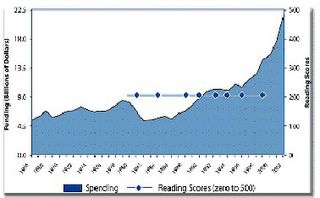
But let's also be realistic. Education has been sheltered from the demands of accountability for far too long. The USDOE always likes to show the graph that compares the amount of dollars invested in education to the reading on grade level indicators for fourth graders.


NAEP Reading Scores Compared to ESEA Funding

It is very depressing to think that over the course of about 25 years and nearly $20 billion invested, that only 20% of fourth graders, as measured by the NAEP exam, are reading on grade level. If you can't read, how can you learn? Seems pretty fundamental to me.

This brings me to where my interests are in education: School improvement processes supported and accelerated by smart technology that is used effectively. Before you can use the technology, you have to do the heavy lifting of process improvement.

PLAN ==> DO ==> CHECK==> ACT

The four fundamental pillars of Deming's Continuous Improvement methodology. These four words have gained importance as continuous improvement has gained ground in the education industry. Leading consultants such as Pat Davenport, Gerald Anderson and Larry Lezzotte have created school improvement processes that either are centered on or contain portions of Deming's methods. So what you say? The interesting thing here is that dramatic successes have been achieved using these processes. So what you say again? The other very interesting thing is that these processes are achieving large scale success in different situations and different districts.

This is exactly what Richard Elmore, Education Chair at Harvard, addresses in his book, "School Reform from the Inside Out." Large scale replication of proven school improvement processes has proven to be a daunting and elusive goal. But recent successes at Brazosport ISD, Fontana USD and others are showing that school improvement processes can be replicated at differing districts with different compositions and different settings.

Where do I think technology fits? More on that in the next post....